Computational screening
Use data and advanced models to identify the genes that guide meiosis and ovarian development.


Our science
We are working to recreate human egg development in the laboratory by combining stem cell biology, computation, and high-throughput screening.
In vitro gametogenesis
In vitro gametogenesis, or IVG, is the process of creating eggs from ordinary cells outside the body.
A woman’s cells can first be converted into stem cells. From there, they can be guided through the stages of development that produce an egg. Those eggs could ultimately be used in IVF.
Our approach
Use data and advanced models to identify the genes that guide meiosis and ovarian development.
Test those biological instructions in human stem cells and observe how they influence cell identity.
Measure the results, improve our models, and use every experiment to design a better next one.
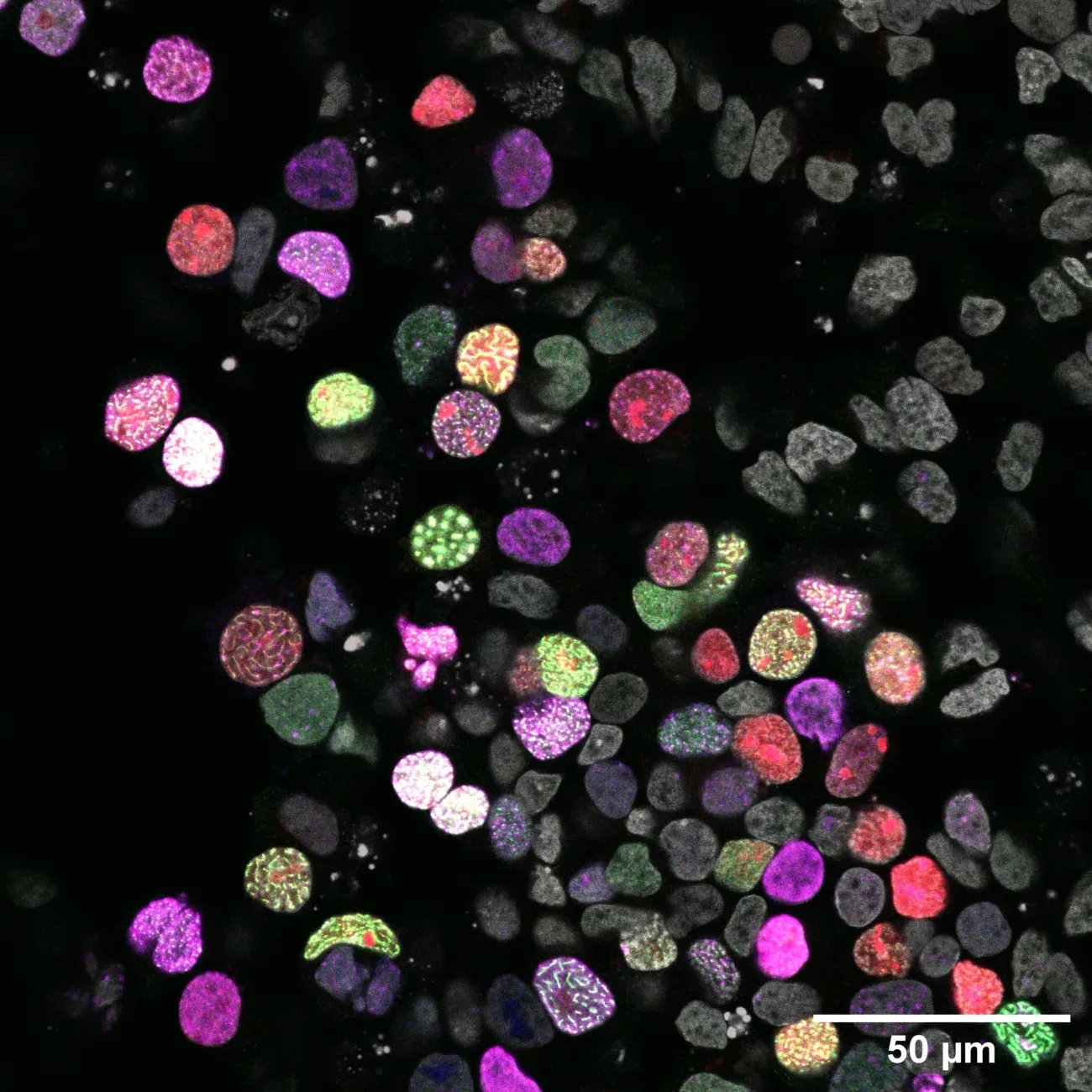
Meiosis induction from human induced pluripotent stem cells. Scale bar: 50 μm.
A critical milestone
Meiosis is the specialized form of cell division required to produce an egg. Activating it has been a key challenge in human IVG.
Ovelle has produced meiotic oogonia-like cells from human induced pluripotent stem cells by controlling the expression of selected genes and RNA-binding proteins. We are now working to place these cells in ovarian organoids that recreate the supporting environment an egg needs to grow and mature.
The path ahead
IVG requires two essential components: egg precursor cells created from a woman’s own cells and ovarian supporting cells that help them grow. Ovelle is working to produce both and bring them together in the laboratory.
Collect ordinary cells through a blood draw or small tissue sample and convert them into stem cells.
Create egg precursor cells from a woman’s own cells, then combine them with ovarian supporting cells that help them grow and mature.
Bring the two cell types together in reconstructed follicles, then support the egg as it grows and matures.
Scientific work
Join a small team working at the frontier of human developmental biology.
View careers